Table Of Content
A curtain that does not close properly, leaves gaps at the sides or hangs unevenly can make even a well-finished room look incomplete. In many cases, the problem begins before the curtains are made: the curtain track has been measured incorrectly.
Accurate measurements help the curtains sit neatly, open and close smoothly, and cover the window properly. You also need to account for more than just the window width. Track position, wall space, brackets, bends, curtain stack and the amount of overlap around the window can all affect the final measurement.
So, how to measure for a curtain track correctly? Start by deciding where the track will be fitted, then measure the required width and drop carefully. This guide walks you through the process step by step.
Before reaching for your tape measure, gather a few basic tools:
It is also useful to note down the type of window, the curtain style you plan to use and whether the curtains will open from the centre or move towards one side.
Why does this matter? A straight window with a centre-opening curtain will require a different approach from a bay window or a curtain that stacks entirely on one side.
First, decide whether you want the track to be wall-fixed or ceiling-fixed.
For a wall-fixed track, the track is usually positioned above the window and extends beyond the window frame on both sides. Many measuring guides recommend allowing approximately 15–30 cm beyond each side of the window to give the curtains room to stack back when open.
For example, imagine your window is 180 cm wide. Instead of making the track exactly 180 cm, you could extend it beyond the window to create additional space for the curtains.
This helps prevent the fabric from sitting directly over the glass when the curtains are open.
Before finalising the position, look for anything that could interfere with the track or curtain movement.
Check for:
A measurement may look perfect on paper but become impractical if the curtain cannot move freely once installed.
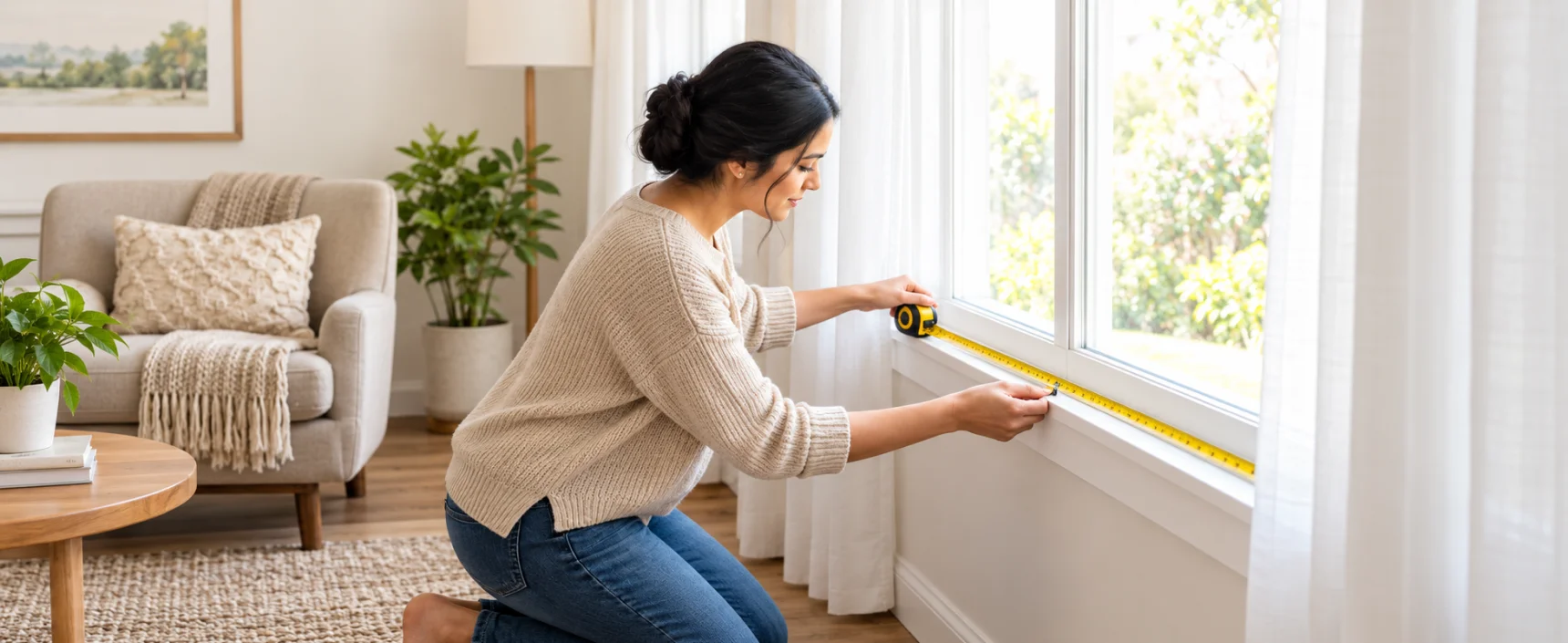
Measure the width of the window opening from one side to the other. Take the measurement at the top, middle and bottom of the opening. Windows and walls are not always perfectly square, so these measurements can sometimes differ.
If you are installing a new track, do not simply use the window width as your final track measurement. You need to account for the extra space required beyond the window.
Example
This is one of the most commonly overlooked parts of curtain track measurement. Stack-back refers to the space occupied by the curtain fabric when it is fully open and gathered to one or both sides.
Imagine you have a large window with a beautiful outdoor view. You install a track that only extends a few centimetres beyond the window. When you open the curtains, the fabric still covers part of the glass.
That is a stack-back problem. The amount of space required depends on the curtain fabric, fullness, lining and heading style. Some professional measuring guidance suggests allowing around 20–25% of the window width as additional track length for stack-back in many situations.
However, this should be treated as a practical starting point rather than a universal formula.
For heavier curtains or fuller designs, you may need more space. If wall space is limited, you may need to consider a one-way draw or another window treatment.
Are you planning to use two curtain panels that meet in the middle? If yes, check whether your chosen curtain track has a centre overlap mechanism.
An overlap allows one curtain panel to pass slightly over the other when the curtains are closed. This can help minimise the gap between the two panels.
If your track includes an overlap, measure the main track width and the overlap separately where required. Some track systems specify the total ordering width as the main track measurement plus the overlap measurement.
For example:
Always check the manufacturer’s measuring instructions because track designs differ.
Once you have established the track width, it is time to measure the drop. The drop is the vertical distance from the point where the curtain will hang to where you want it to finish.
Decide first whether you want:
For floor-length curtains, measure from the top of the track to the floor. Do not take just one measurement.
Measure at:
Floors and ceilings can be slightly uneven, so these measurements may vary. Using the shortest measurement can help prevent the finished curtain from dragging on the floor.
Example
Suppose your three measurements are:
Using the shortest measurement gives you a safer starting point for determining the curtain drop.
Another important measurement is the distance between the wall and the curtain track. Why? Because curtains need enough space to move without rubbing against window handles, frames, radiators or other obstructions.
This becomes particularly important when you are using wave curtains, lined curtains or thicker fabrics.
For example, a window handle that sticks out several centimetres may interfere with the curtain if the track is mounted too close to the wall.
Measure the depth of any obstruction and compare it with the projection of the track and brackets.
A straight track works well for standard rectangular windows and larger openings.
For motorised smart curtains tracks accurate measurements become even more important. You need to consider track length, curtain weight, movement direction and available space for the curtain stack. Do not assume that a standard track measurement will work for every motorised installation.
Before you order your curtain track, write down all your measurements clearly. Your checklist should include:
Then measure everything one more time. It may take an additional five minutes, but it can save you from ordering a track that is too short or positioning it where the curtains cannot move properly.

A correctly measured curtain track does more than make installation easier. It affects how the curtains look, move and function every day.
A well-positioned track can allow curtains to open further, frame the window properly and create a more balanced appearance. It can also help prevent unnecessary fabric bunching around the glass.

Before placing your order, ask yourself:
If the answer to all five is yes, you are much closer to getting a track that fits both your window and your curtain design.
Measuring for a curtain track does not have to be complicated. The key is to look beyond the window itself and consider how the curtains will actually move, where they will stack and what might get in their way.
Take your time, measure more than once and record every dimension before ordering. With the right measurements, you can create a curtain installation that looks neat, operates smoothly and makes better use of your available window space.
Looking for a curtain track that combines functionality with a clean, stylish finish? Explore Ferbo’s range of curtain tracks and find a solution designed to complement your windows and make everyday curtain operation easier.
Related Product
We would love to speak with you. Feel free to reach out using the below details.
Other related blogs
If a Curtain track is already installed and you are replacing the curtains, measure the usable track width. If you are installing a new track, measure the window first and then allow additional width for stack-back and clearance.
WhatsApp us